Chamber 01
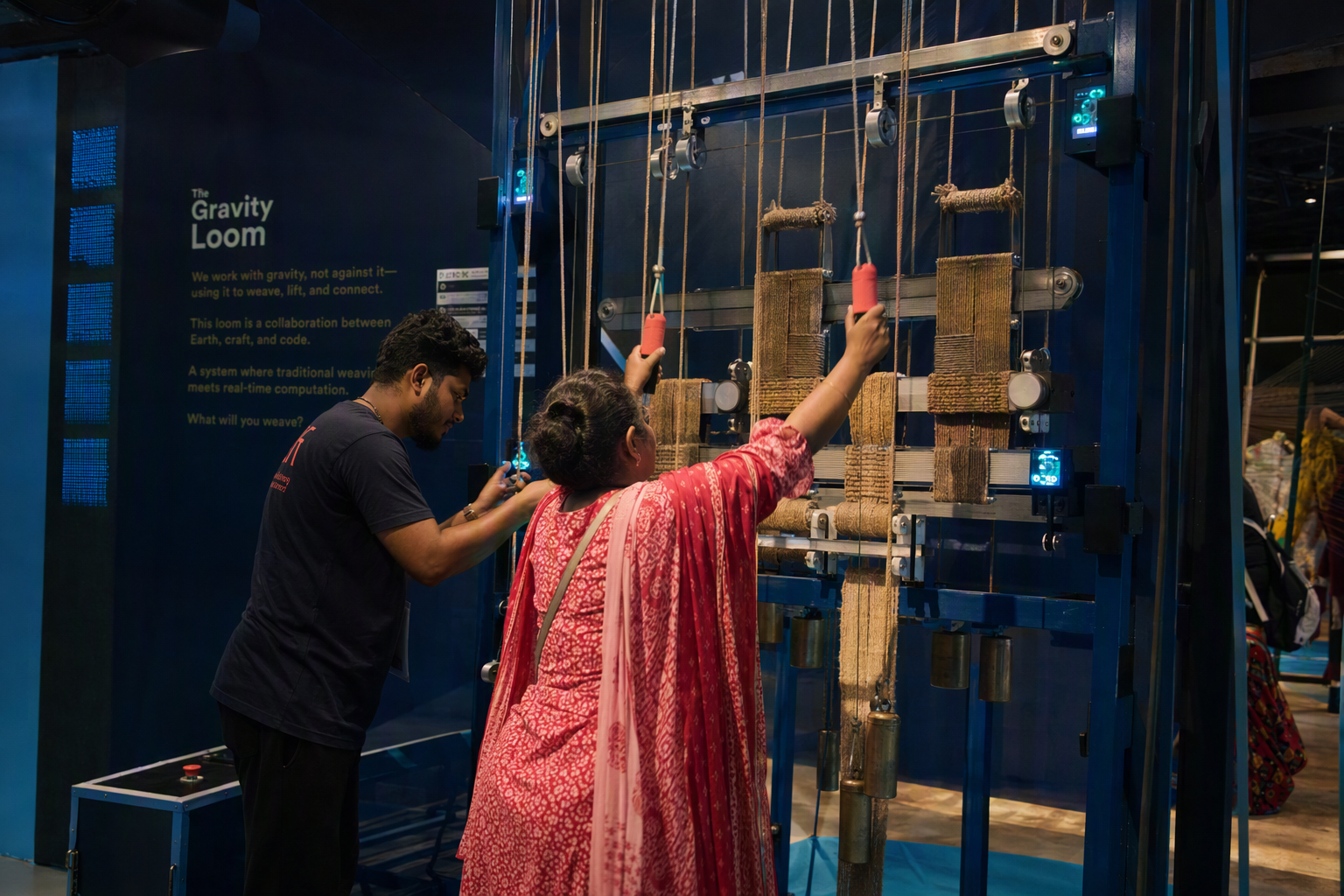
The Gravity Loom
Pull one weighted shuttle and the entire luminous weave changes. Add mass, compare steep and shallow curves, then send a small sphere across the field to see how its path responds.
Flagship exhibit · North Court
Step into a working model of a star system. Shape gravity with woven light, reveal the fingerprints hidden inside starlight, and build an orbit with everyone in the room.
Matter, motion, making
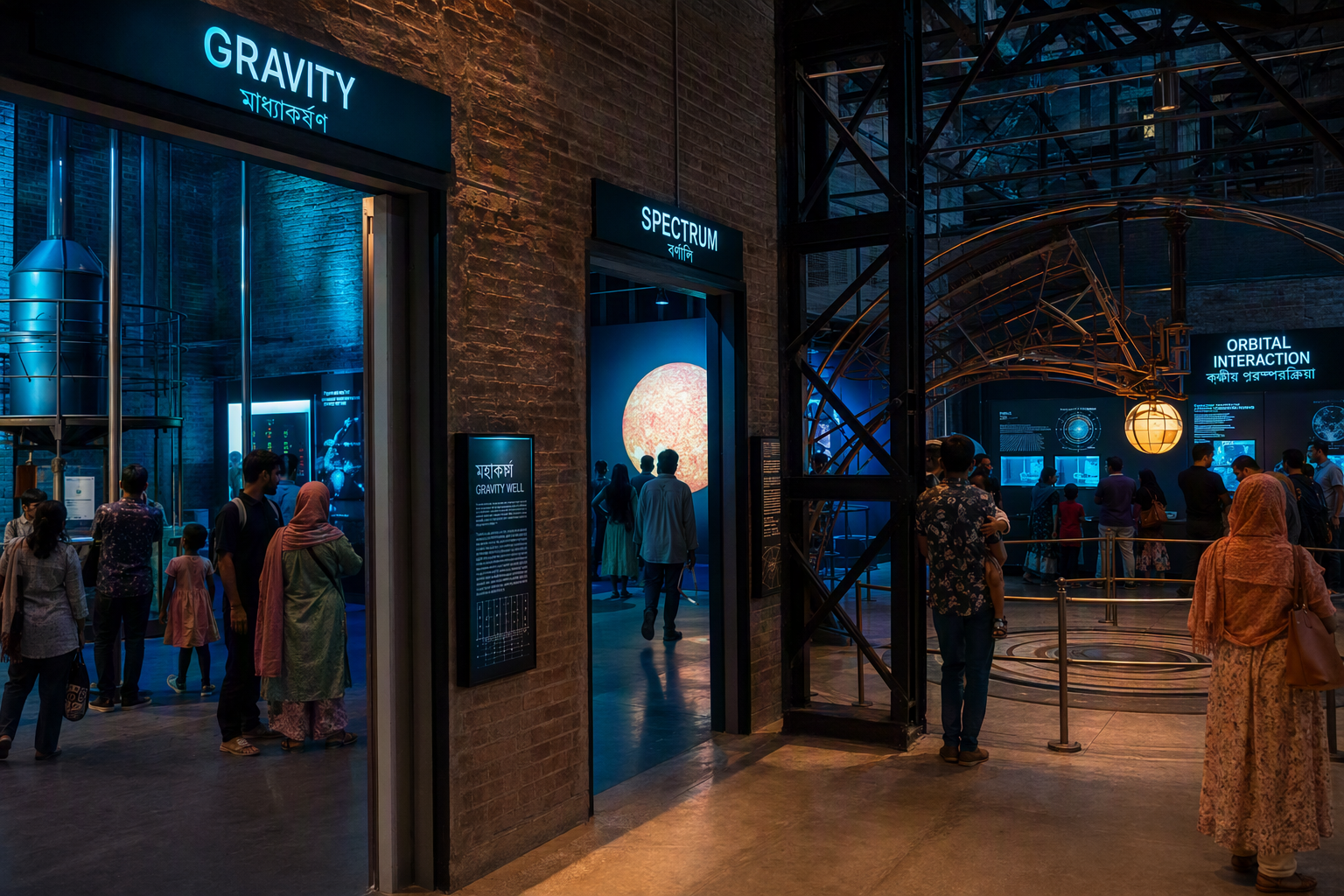
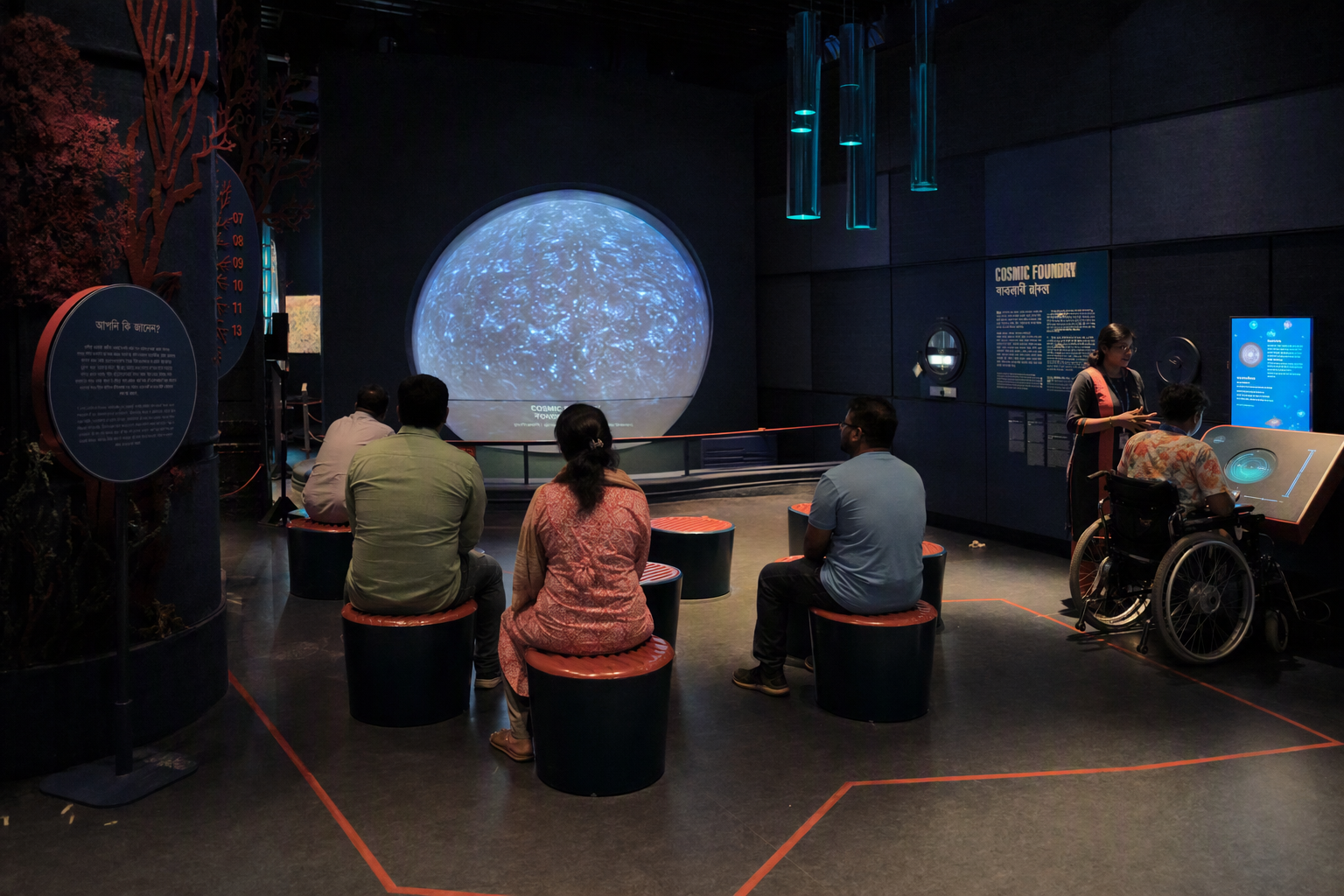
Stars can feel impossibly remote. Cosmic Foundry brings their governing ideas down to hand height through thread, glass, projected light, weighted tools, and a floor that responds to the way people move together.
Your route begins with a question: how can something invisible guide an entire system? In the first chamber, tension in a field of cords makes gravity visible. In the second, prisms and filters unpack a beam into evidence about temperature and material. The final chamber asks the whole group to keep a set of orbiting bodies stable.
There is no single score and no expert route. You can observe from the edge, operate one station, or stay with an idea long enough to test it again. Hosts connect each experiment to real techniques used by astronomers, while keeping the encounter conversational and open-ended.
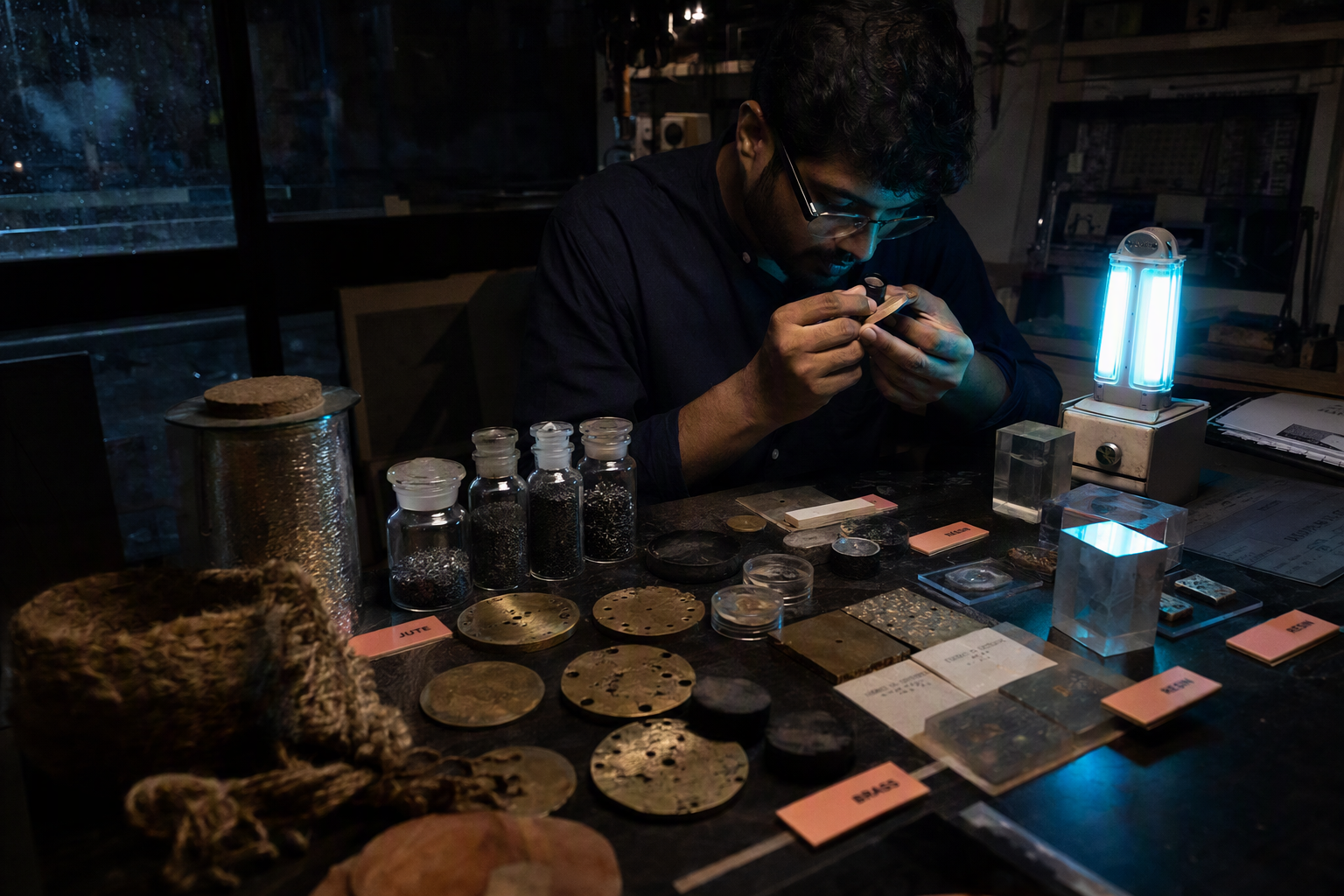
Start with this: Choose one “stellar material” token. Its weight, color, and texture become your clue as you move through all three chambers.
A three-part journey
Each chamber changes the scale of the question, from the pull between two objects to the choreography of a whole system.
Chamber 01
Pull one weighted shuttle and the entire luminous weave changes. Add mass, compare steep and shallow curves, then send a small sphere across the field to see how its path responds.
Chamber 02
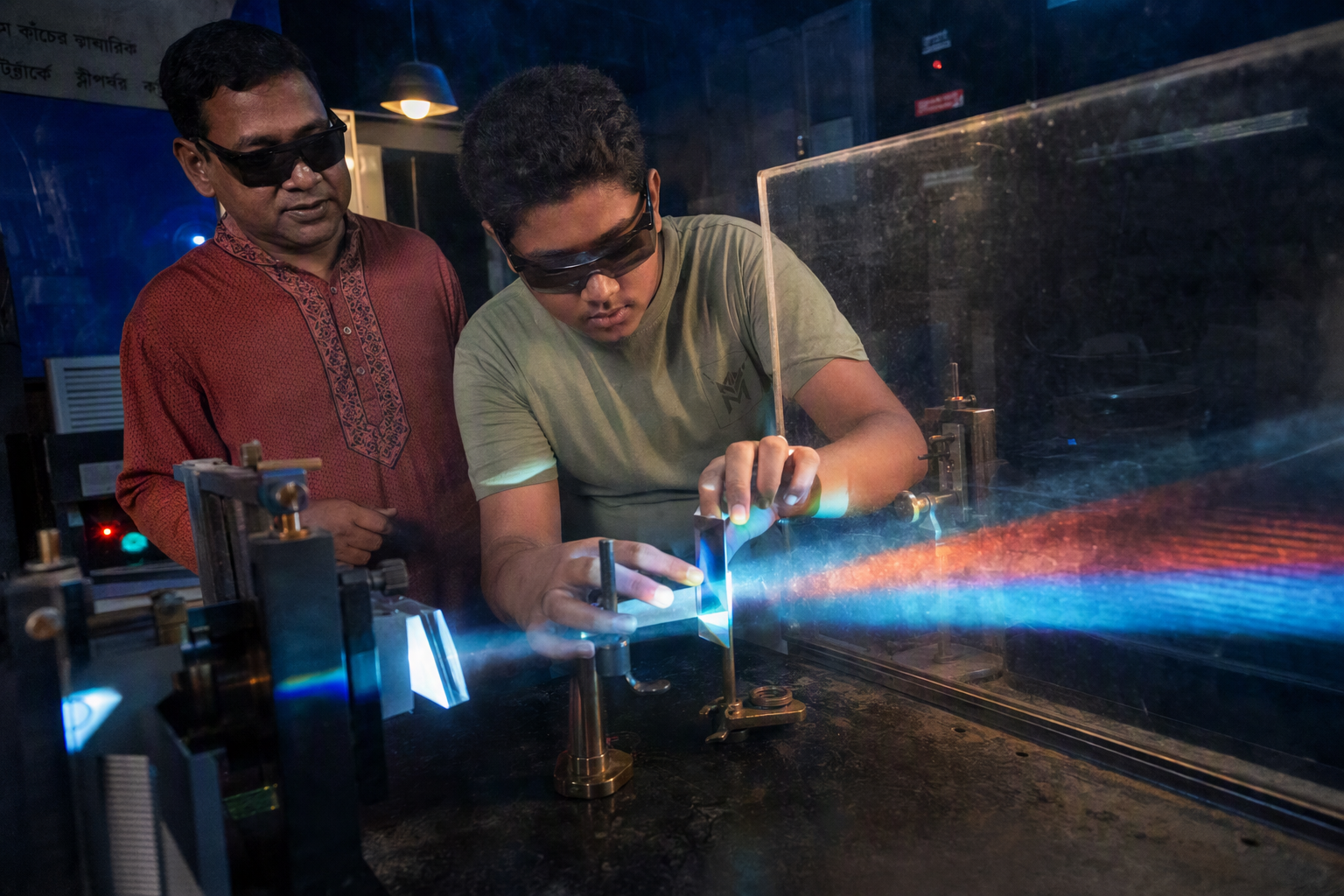
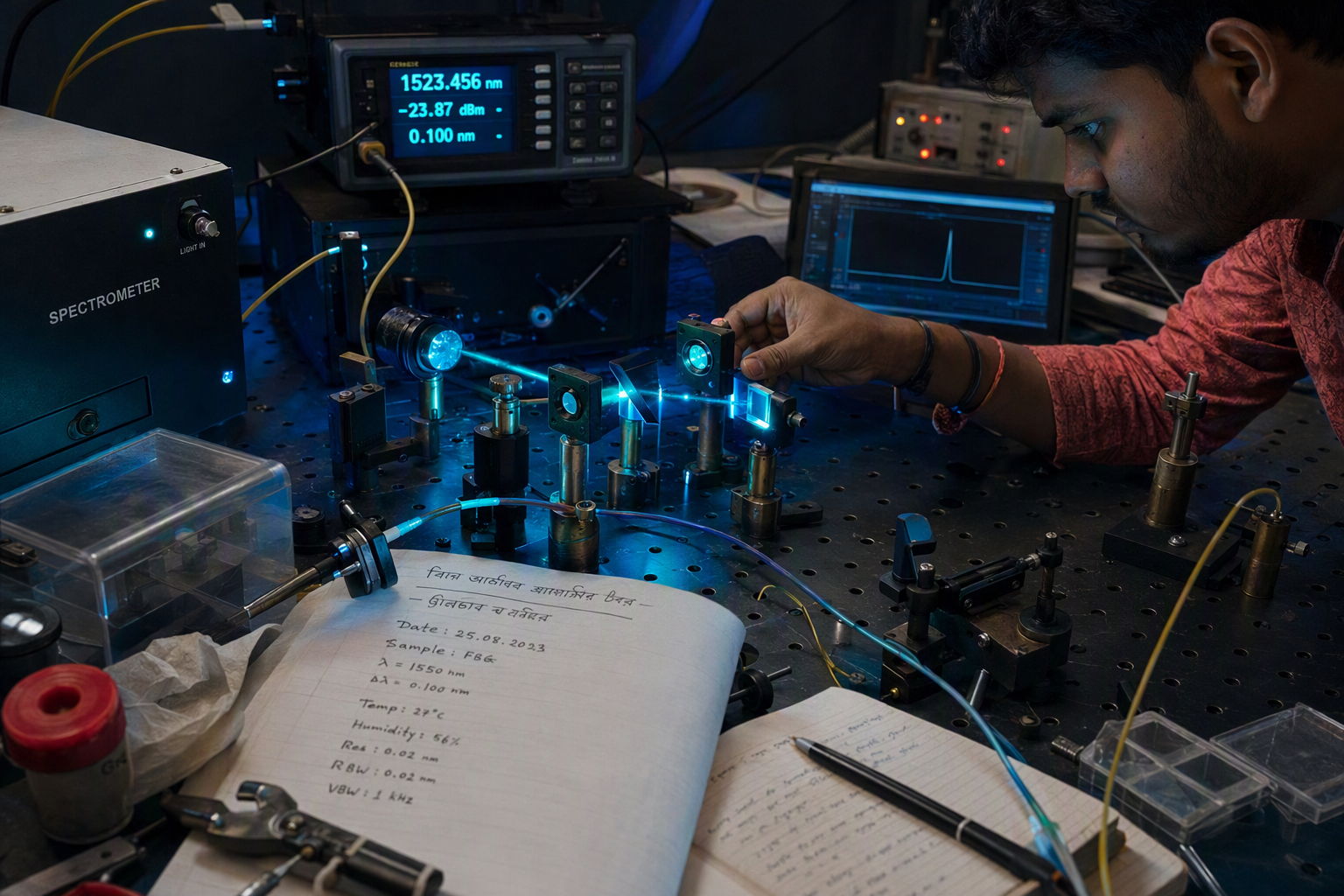
Feed a beam through prisms, gases, and color filters. Match bright and dark lines to your material token, and discover how astronomers identify elements without collecting a physical sample.
Chamber 03
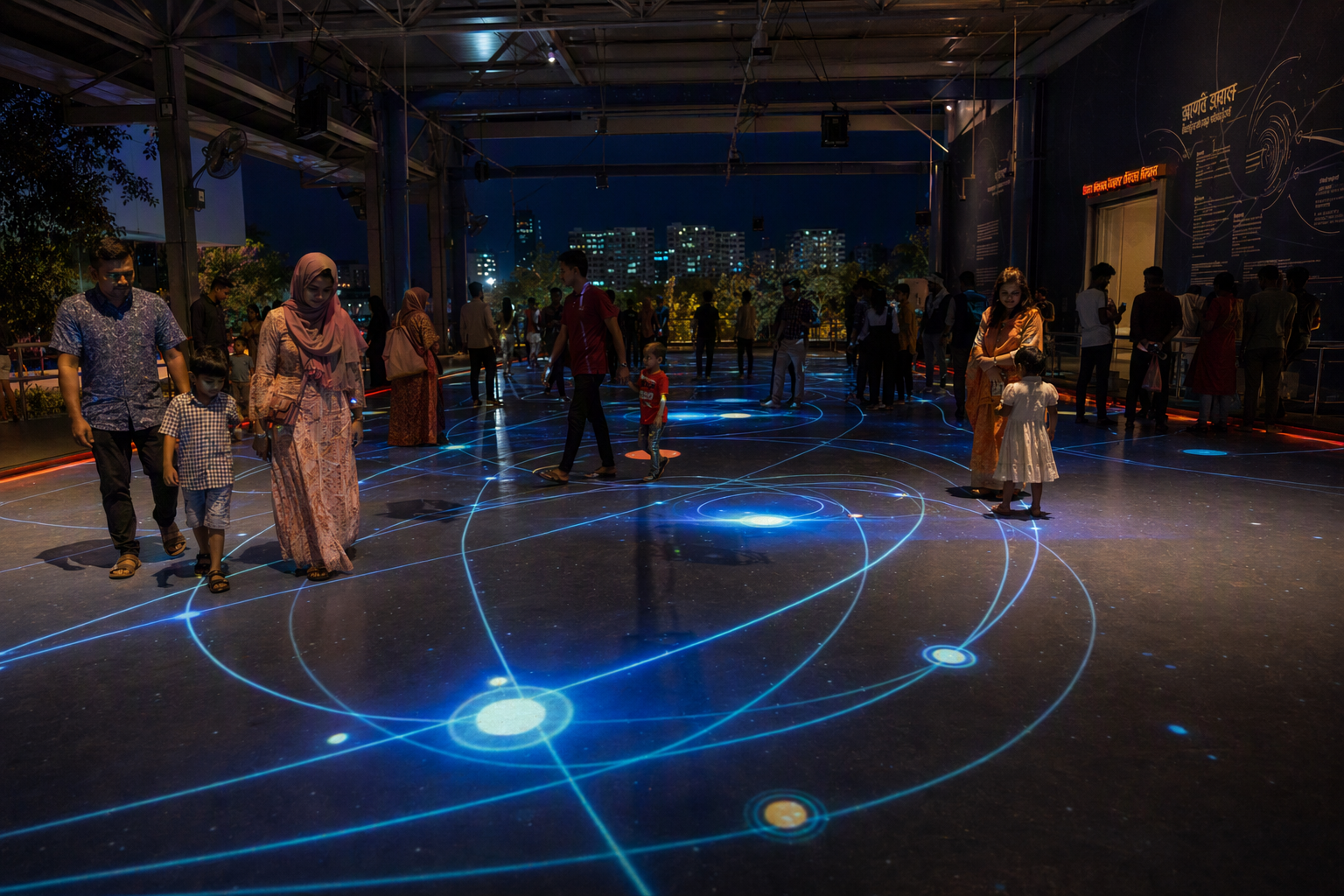
Become part of a many-body system. Your position changes the projected paths underfoot, so the room must negotiate where to stand, when to move, and how to restore a stable orbit.
The learning story
Cosmic Foundry follows one chain of reasoning: motion reveals forces, light reveals matter, and repeated paths reveal the structure of a system.
Mass changes the motion around it. The loom is a physical analogy rather than a literal model of space, but its curved paths help visitors ask why moons fall around planets instead of straight toward them.
When light is separated by wavelength, bright or dark spectral lines can reveal which elements emitted or absorbed it. The forge uses hydrogen, sodium, and neon reference patterns so visitors can compare evidence rather than guess from color alone.
Stable systems balance speed, direction, and gravitational attraction. On the Orbit Floor, one person’s movement affects everyone else’s result, echoing the complexity of systems with several interacting bodies.
Take the question onward: If scientists cannot visit a star, what else can they learn from the light and motion that reach us?
Know before you enter
The complete route is step-free and every chamber can be experienced by watching, listening, reading, or using an alternate control.
Practical visit facts
Entry is managed in small waves so each group has room to use the shared installations.
Allow 10 minutes to travel from the ground-floor galleries. The visit planner can place nearby exhibits before or after this stop.
Continue the investigation
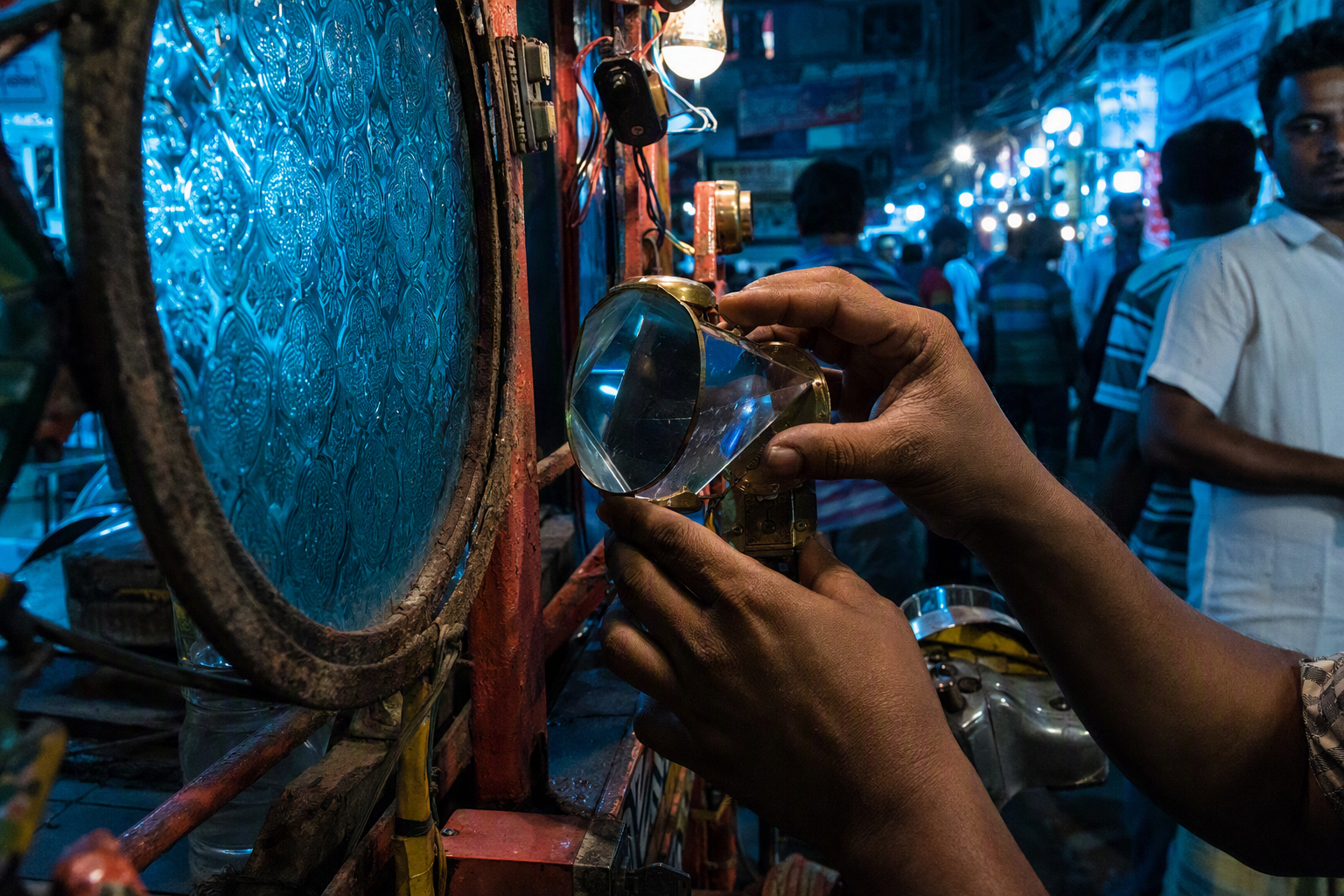
Continue from spectroscopy into refraction, color mixing, and the way patterned surfaces reshape a beam.
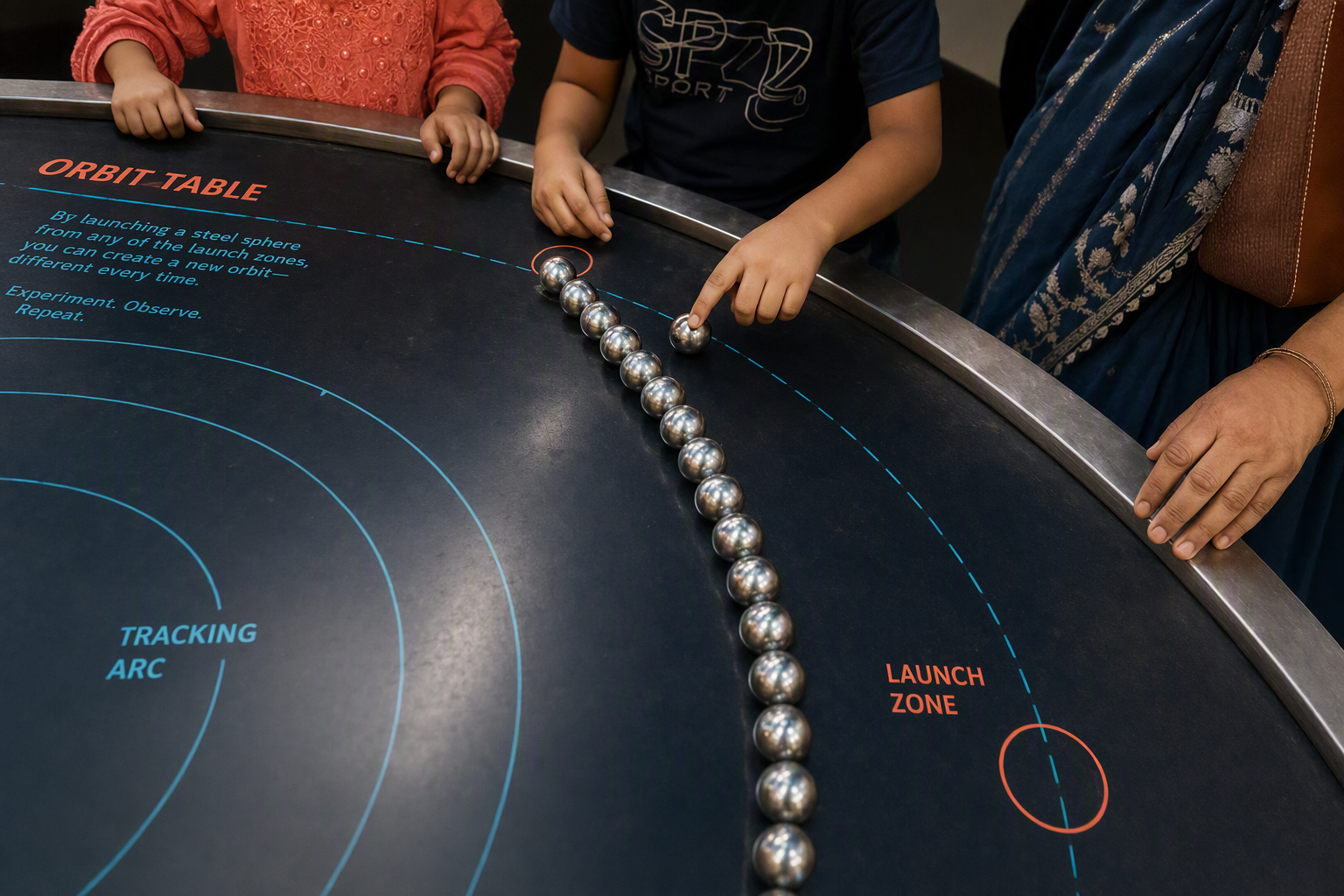
Test orbital speed and direction at tabletop scale, just steps from Cosmic Foundry’s room-sized system.
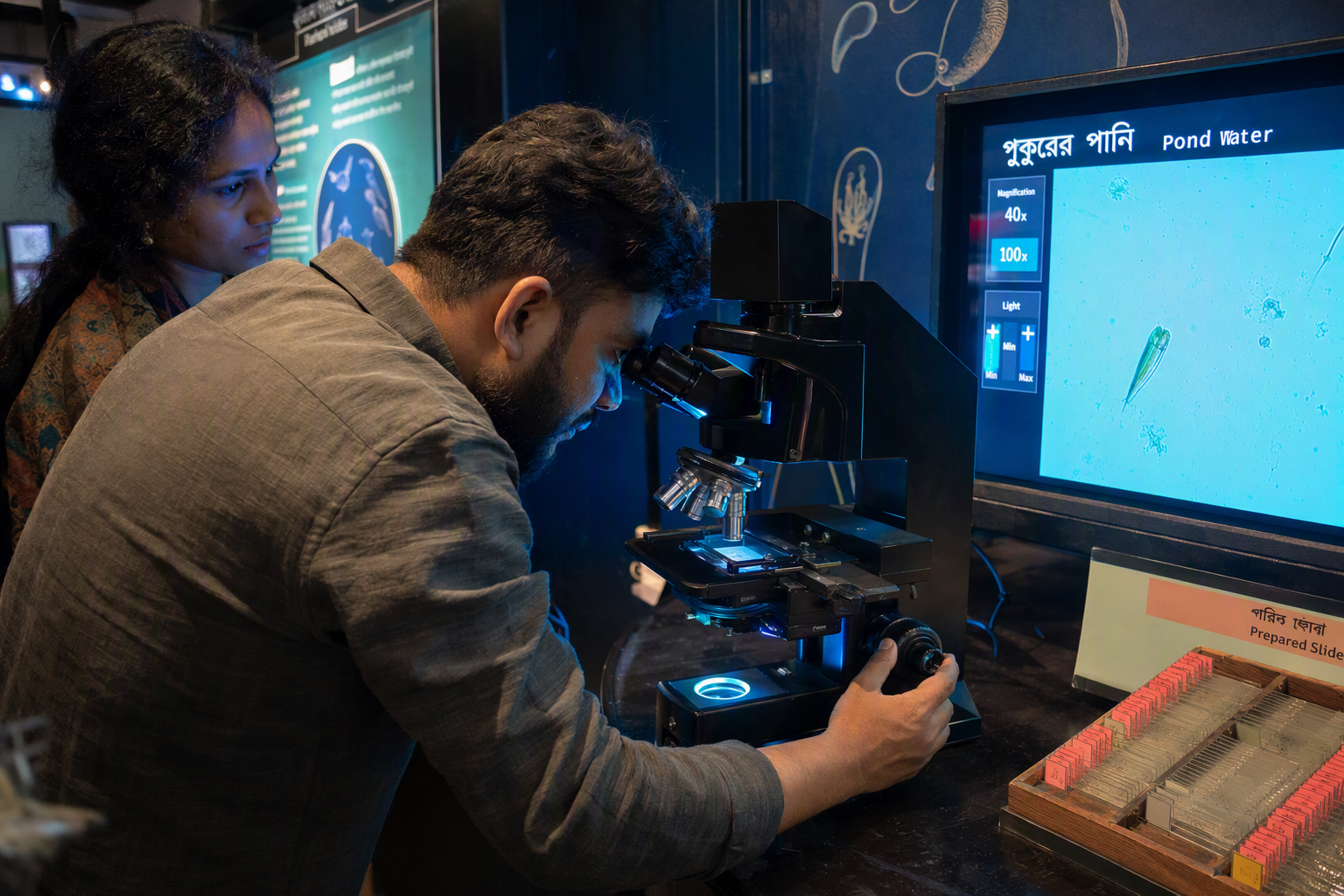
Reverse the scale of your journey and use instruments to gather evidence from matter too small to see unaided.